E : aitech@pmfst.com
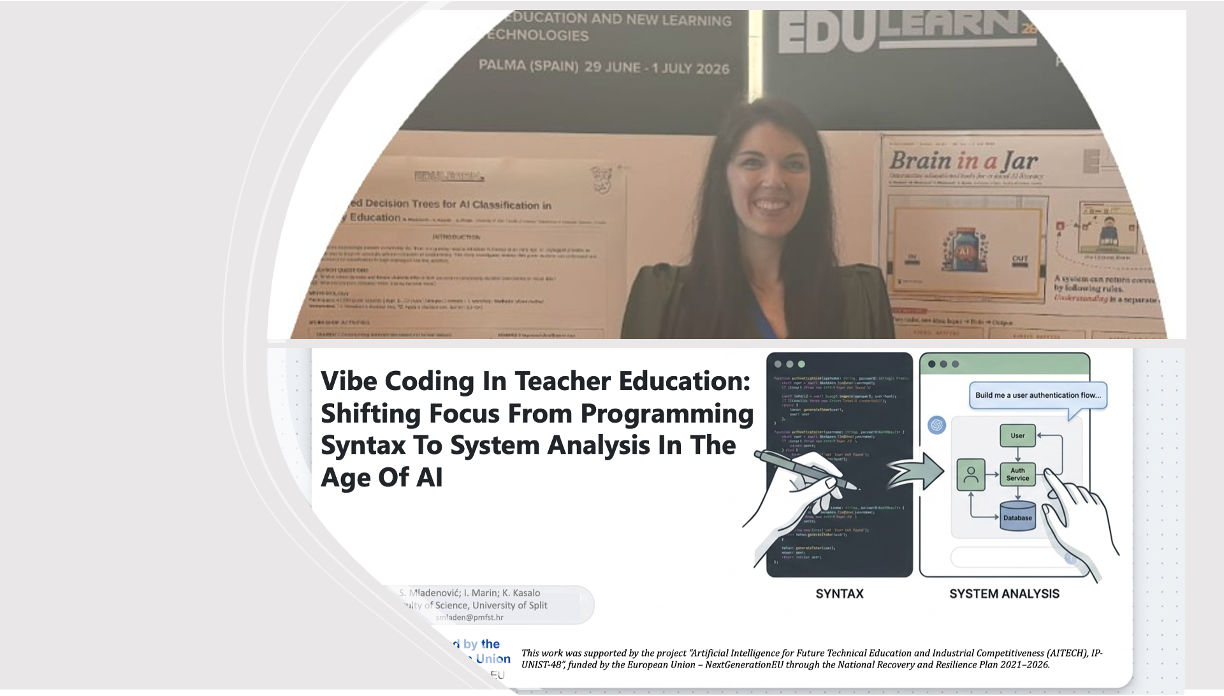
Research on Vibe Coding in Teacher Education Presented at EDULEARN26
June 30, 2026
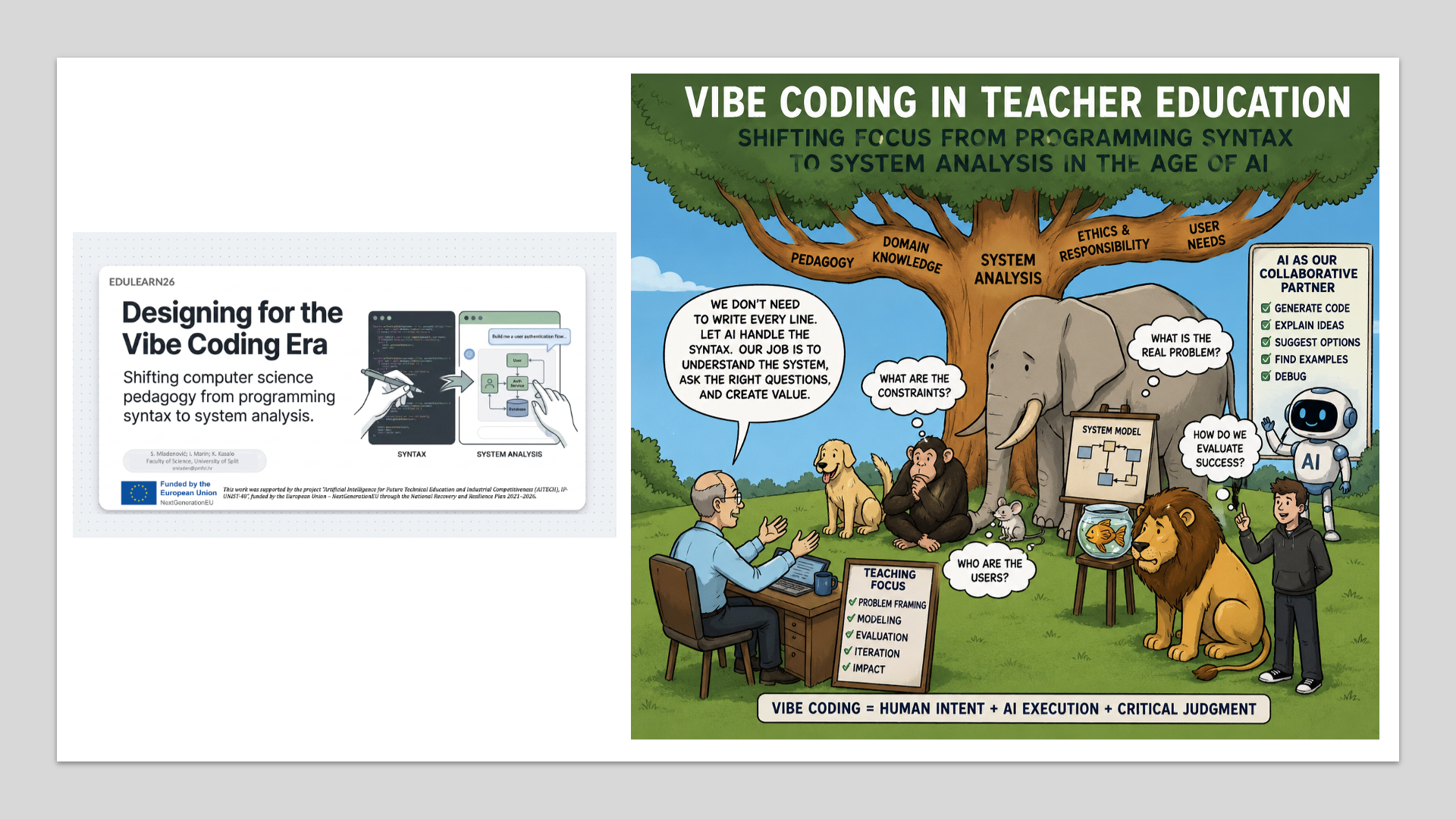
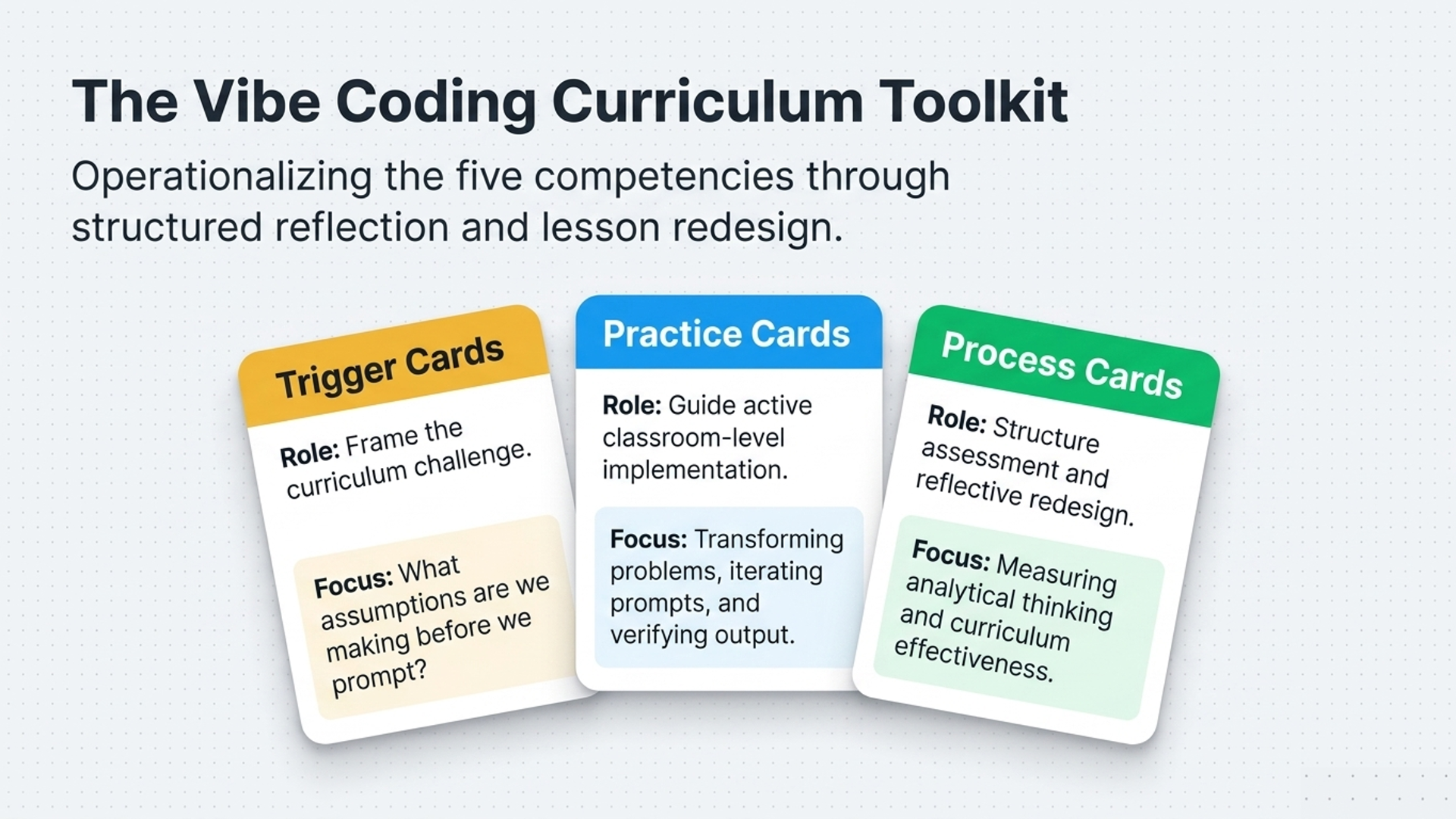
AITech researchers presented the paper “Vibe Coding in Teacher Education: Shifting Focus from Programming Syntax to System Analysis in the Age of AI” at EDULEARN26 in Palma, Spain. The paper proposes a pedagogical framework and card-based curriculum toolkit for integrating AI-assisted programming into teacher education, with emphasis on problem framing, validation logic, human oversight, and responsible human-AI collaboration.
The paper addresses a highly relevant question for contemporary computer science education: what should programming education focus on when generative AI tools can increasingly produce syntactically correct code from natural language prompts? The authors argue that the rise of AI-assisted programming does not reduce the importance of programming education. Instead, it changes its centre of gravity. When AI can support code production, education must place stronger emphasis on problem formulation, system analysis, validation, explanation, and responsible human oversight.
The concept of vibe coding is used in the paper to describe AI-assisted development in which natural language prompts guide code generation and iterative refinement. In educational contexts, however, the authors do not interpret vibe coding as a shortcut around programming knowledge. On the contrary, they use it as a starting point for rethinking how future teachers should be prepared to design and supervise programming activities in an AI-augmented learning environment. The key message of the presentation was that when AI writes the code, the human must design the system.
The framework identifies five competency dimensions that future teachers need in order to use AI-assisted programming meaningfully and responsibly: Problem Framing, Prompt Engineering, Validation Logic, Human Oversight, and Reflective Curriculum Design. These dimensions do not replace traditional computational thinking. Rather, they extend it by including the competencies needed for human-AI collaboration in software development and education.
The contribution is closely aligned with the broader goals of the AITECH project. AITECH focuses on the responsible integration of artificial intelligence into technical education and on developing educational models that prepare learners for an AI-augmented technological and industrial environment. By connecting AI literacy, teacher education, programming pedagogy, and human-centred system analysis, the presented work contributes to the project’s mission of strengthening future technical education and industrial competitiveness.
The presented research was carried out within the project “Artificial Intelligence for Future Technical Education and Industrial Competitiveness (AITECH), IP-UNIST-48”, funded by the European Union – NextGenerationEU through the National Recovery and Resilience Plan 2021–2026.
Funded by the European Union – NextGenerationEU.
The views and opinions expressed are solely those of the author and do not necessarily reflect the official position of the European Union or the European Commission. Neither the European Union nor the European Commission can be held responsible for them.
CALL TITLE: Call for Funding of Institutional Research Projects of the University of Split, under the National Recovery and Resilience Plan 2021–2026 (NRRP), and the Programme Agreement concluded between the University of Split and the Ministry of Science, Education and Youth.
PROJECT TITLE: Artificial Intelligence for Future Technical Education and Industrial Competitiveness
FUNDING DECISION: CLASS: 029-03/25-01/16, REG.NO.: 2181-202-3-01-6, issued on 20 October 2025.
TOTAL PROJECT VALUE: €222,203.10
BENEFICIARY: Faculty of Science, University of Split
PROJECT LEADER: Prof. Saša Mladenović, PhD