E : aitech@pmfst.com
Research on Vibe Coding in Teacher Education Presented at EDULEARN26
November 5, 2025
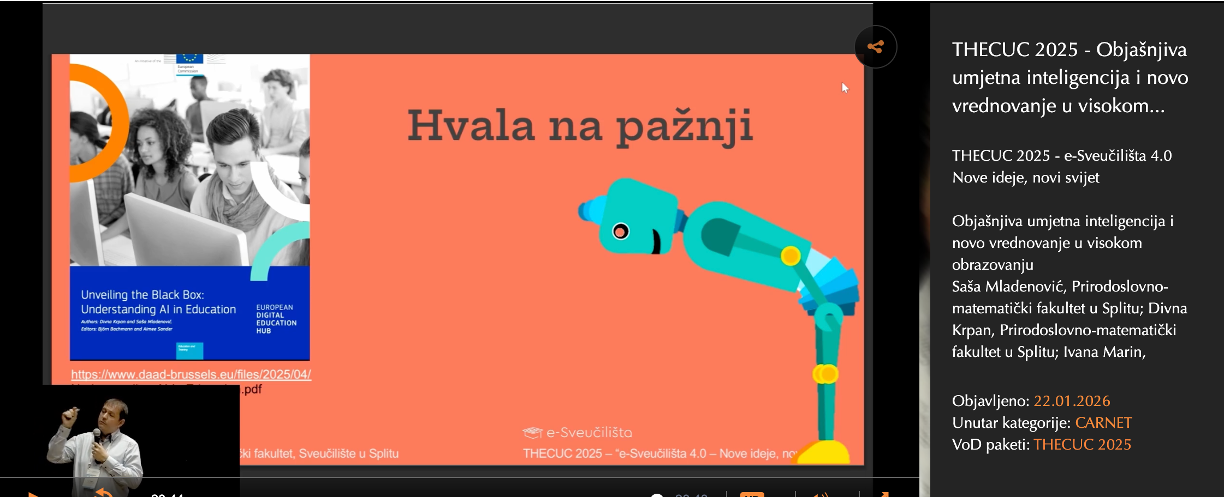
Presented at THECUC 2025 in Rovinj, this work prepared by Saša Mladenović, Divna Krpan, and Ivana Marin (Faculty of Science, University of Split) explores how explainable AI can transform assessment practices in higher education through transparency, adaptability, and human-in-the-loop approaches.
A key contribution of the research is the explicit connection between biologically and cognitively inspired AI models and established learning theories, including constructivism (Piaget), social constructivism (Vygotsky), behaviorism (Skinner), and connectivism (Siemens). This alignment provides a theoretical foundation for designing AI-supported assessment that is not only technically robust but also pedagogically grounded.
The work was developed within the AITECH project (Artificial Intelligence for Future Technical Education and Industrial Competitiveness, IP-UNIST-48), funded by the European Union – NextGenerationEU through the National Recovery and Resilience Plan 2021–2026.
Tag :
Share This :
Funded by the European Union – NextGenerationEU.
The views and opinions expressed are solely those of the author and do not necessarily reflect the official position of the European Union or the European Commission. Neither the European Union nor the European Commission can be held responsible for them.
CALL TITLE: Call for Funding of Institutional Research Projects of the University of Split, under the National Recovery and Resilience Plan 2021–2026 (NRRP), and the Programme Agreement concluded between the University of Split and the Ministry of Science, Education and Youth.
PROJECT TITLE: Artificial Intelligence for Future Technical Education and Industrial Competitiveness
FUNDING DECISION: CLASS: 029-03/25-01/16, REG.NO.: 2181-202-3-01-6, issued on 20 October 2025.
TOTAL PROJECT VALUE: €222,203.10
BENEFICIARY: Faculty of Science, University of Split
PROJECT LEADER: Prof. Saša Mladenović, PhD